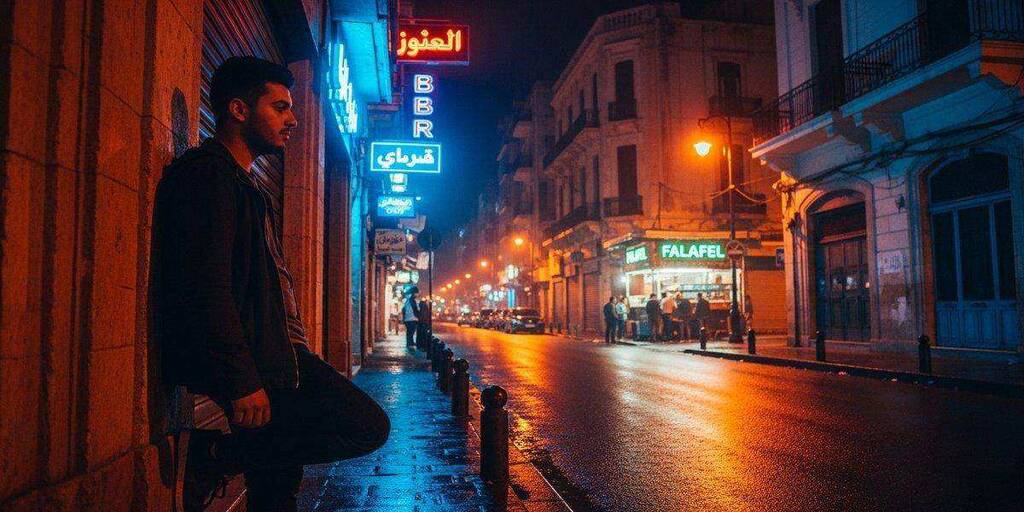
Beirut has been the subject of countless films about war, but Michel Kammoun’s Falafel is about what comes after — the strange, suspended state of a city that has stopped fighting but has not yet figured out how to live. His debut feature follows a group of young people drifting through the Lebanese capital on a single night, their encounters mapping a city that is rebuilding its buildings but not yet its sense of purpose.
The title — the name of a street food that is simultaneously Lebanese, Palestinian, Israeli, Egyptian, and universal — signals Kammoun’s interest in the shared textures of Mediterranean urban life. His Beirut is not the Beirut of political analysis; it is the Beirut of late-night taxis, rooftop conversations, chance encounters at traffic lights, and the particular energy of a city where everyone under thirty seems to be simultaneously planning to leave and unable to imagine living anywhere else — the same city that produced Yasmine Hamdan and Soapkills.
A City Between States
Kammoun shoots Beirut with the eye of someone who knows its geography intimately — the invisible borders between neighborhoods, the construction cranes that have become as much a part of the skyline as the minarets and church steeples, the seaside corniche where all social classes briefly share the same view. His camera moves through the city with a restlessness that mirrors his characters: never settling, never arriving.
The performances are uniformly excellent, drawing on Beirut’s vibrant theater scene. Kammoun works with a loose, improvised feel that recalls early Cassavetes, allowing his actors space to inhabit their characters rather than merely perform them.
Post-War Cinema
Falafel won the Bayard d’Or for Best Film at the Namur International Film Festival in Belgium, where its portrait of a generation caught between trauma and hope resonated with European audiences familiar with their own post-conflict cities. The film was also featured in EuroMed Café’s programming as an example of the new Lebanese cinema that emerged in the early 2000s — a wave that includes Nadine Labaki’s Caramel, Ziad Doueiri’s West Beirut, and Danielle Arbid’s A Lost Man. The tradition these filmmakers inherited goes back to Youssef Chahine, who championed Arab cinema on the world stage.
What distinguishes Kammoun from his peers is his refusal to explain Beirut to outsiders. Falafel does not provide historical context, political analysis, or cultural translation. It simply drops the viewer into the city and says: this is what it feels like to be young here, right now. That immediacy is the film’s greatest achievement — and the reason it endures.